
The Limestone Backbone: An Introduction to the Serra de Tramuntana
There is a weight to the air when you climb above the tree line in the Serra de Tramuntana. It is not the heavy humidity of the coast, but a stillness that belongs to the limestone. This mountain range runs for 90 kilometres along the western spine of Mallorca, stretching from the quiet cliffs of Andratx to the wind-beaten lighthouse at Formentor. For those of us who grew up here, the Serra is more than a landscape: it is the wall that protects us from the northern winds and the well that holds our water. My dog, Cala, knows these trails better than I do, often pausing at the edge of a *penya* (cliff) to watch the Mediterranean shift from turquoise to deep navy a thousand metres below. It is a proper wilderness, mind you, where the silence is only interrupted by the rhythmic cling-clang of goat bells.
The range occupies nearly a third of the island’s territory. It is a world apart from the sandy stretches of the south. Here, the land is vertical and the roads are narrow ribbons of asphalt that test the nerves of even the most seasoned drivers. People often ask why Mallorca is so famous, and while teh beaches are part of the answer, it is this rugged spine that gives the island its soul. You will find that the Serra is the reason Mallorca has been filmed in so many movies, including “Cloud Atlas” and “The Night Manager,” because the dramatic scale of these peaks feels more like the Alps than a Mediterranean island. It is a place I have spent my whole life getting lost in.
A UNESCO Cultural Landscape: Man, Water, and Stone
In 2011, UNESCO inscribed the Serra de Tramuntana as a World Heritage Site, but they did not do it for the views alone. They classified it as a “Cultural Landscape.” This means the value lies in the thousand-year relationship between the people of Mallorca and a very unforgiving environment. To survive here, our ancestors had to master the art of water management. You can see this in the *qanats* (underground channels) and the complex irrigation systems that the Moors perfected centuries ago. These systems still direct mountain runoff to the orange groves of Sóller today. You can read the [Official UNESCO Evaluation] for a deeper look at why this symbiosis is so unique.
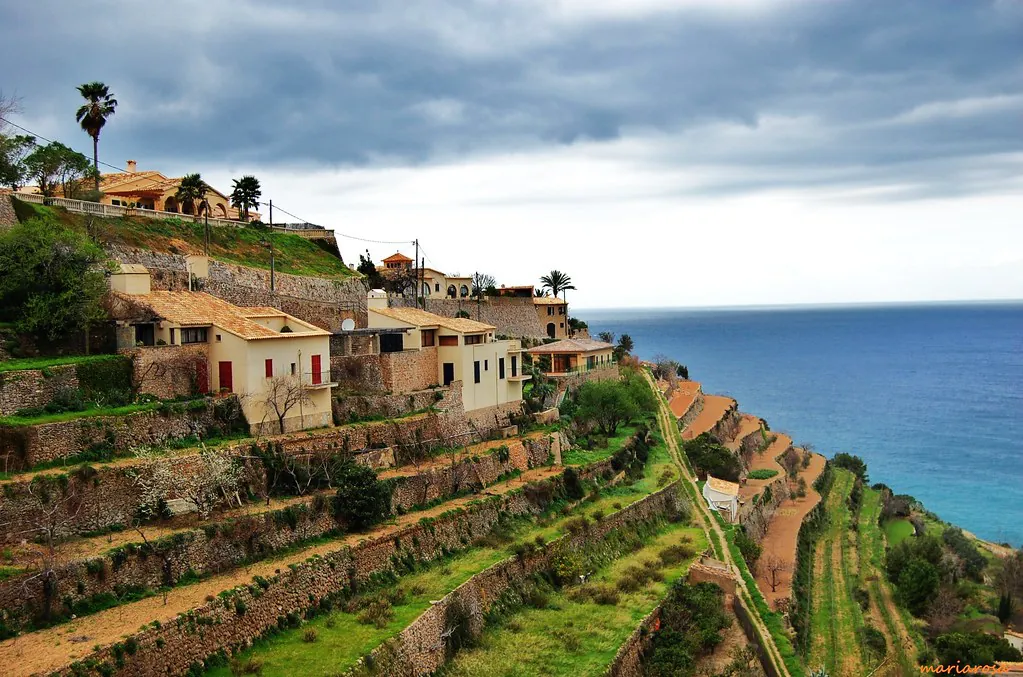
The most visible mark of human hands is the *pedra en sec* (dry stone) technique. Without a single drop of mortar or cement, generations of *margers* (stonemasons) built thousands of kilometres of terrace walls, known as *marjades*. These walls prevent erosion and allow us to grow olives on slopes where most things would simply wash away. It is a staggering feat of engineering that holds the entire mountain together. When you walk the paths, you are walking on stones placed by hand four or five centuries ago.
Local Tip: If you want to see the most impressive terraces, head to the village of Banyalbufar. The “staircase” of stone walls descending to the sea is one of the best examples of Moorish agricultural genius on the island.
The GR 221: A Pilgrim’s Progress on the Dry Stone Route
For hikers, the ultimate way to experience the range is the GR 221, also known as the Dry Stone Route (*Ruta de Pedra en Sec*). It covers approximately 140 kilometres and is divided into eight official stages. It starts in the south at Port d’Andratx and finishes in the north at Pollença. Cala and I usually tackle sections of it during the cooler months, as the summer sun makes the limestone reflect heat like an oven. The route is now fully signposted, which is a massive improvement over the vague cairns we used to rely on a decade ago. You can find maps and status updates on the [Consell de Mallorca website].
| Stage | Route Section | Approx. Distance | Difficulty |
|---|---|---|---|
| Stage 3 | Estellencs to Esporles | 15 km | Moderate |
| Stage 5 | Deià to Port de Sóller | 13 km | Easy/Moderate |
| Stage 6 | Port de Sóller to Tossals Verds | 28 km | High |
| Stage 8 | Lluc to Pollença | 17 km | Moderate |
The beauty of the GR 221 is the network of mountain refuges (*refugis*). These are not the basic huts you might find elsewhere; they are often beautifully restored historic buildings like Son Amer or Muleta. They offer a proper bed and a hot meal of *arròs brut* (spiced “dirty” rice) for a very reasonable price. You must book these well in advance, especially in spring, as they are popular with hikers from all over Europe. Ending a day of walking with a glass of local wine while watching the sunset over the peaks is something every visitor should experience at least once.
Puig Major and the Restricted Peaks
At 1,445 metres, Puig Major is the highest point on the island. You can see its distinctive “golf ball” radar station from almost anywhere in the central plain. However, you cannot actually reach the summit. It has been a restricted military zone since the mid-20th century. For hikers wanting the highest accessible peak, the Puig de Massanella (1,365m) is the one to aim for. The climb is strenuous, but the view across the Embassament de Cúber reservoir and the rest of the island is unmatched. On a clear day, you can see all the way to Menorca. Mind you, the weather can change in minutes up there, so always carry a proper jacket even if it is thirty degrees in Palma.

Santuari de Lluc: The Spiritual Heart
Deep in the mountains of Escorca lies the Santuari de Lluc. It has been a place of pilgrimage since the 13th century when, according to legend, a local shepherd found a dark wooden statue of the Virgin Mary in a cleft of rock. Today, *La Moreneta* (The Black Madonna) sits in the basilica, attracting thousands of visitors every year. Lluc is more than a church; it is the cultural heart of the Serra. It has a museum, a botanical garden, and a famous choir school. Hearing the *Blauets* (the choir boys, named for their blue cassocks) sing the “Salve” at 13:15 is a haunting experience that stays with you long after you leave.
If you plan to visit Lluc, here are the practical details you will need. The atmosphere is most peaceful in the early morning before the tour buses arrive from the coast. It is a great base for exploring the surrounding peaks, and you can even stay overnight in the former monk cells, which have been converted into simple guest rooms. It is one of the few places where you can hear nothing but the wind in the holm oaks at night.
| Basilica Hours | 08:30 – 19:30 (Daily) |
| Museum Entry | €5.00 |
| Parking Fee | €9.00 per day |
| Official Website | lluc.net |
Torrent de Pareis: The Great Descent
Mallorca’s most legendary and demanding hike is the descent of the Torrent de Pareis. This karst canyon starts near Escorca and winds its way down between limestone walls that rise 200 metres high, eventually opening up at the beach of Sa Calobra. It is not a walk; it is a scramble. There is no marked trail, only a series of boulders that require you to jump, slide, and climb. I only do this with Cala when the water levels are perfectly low, as the “Gorg Blau” section can be treacherous after rain. Every year, the local emergency services have to rescue hikers who underestimate the difficulty or teh heat inside the gorge walls.
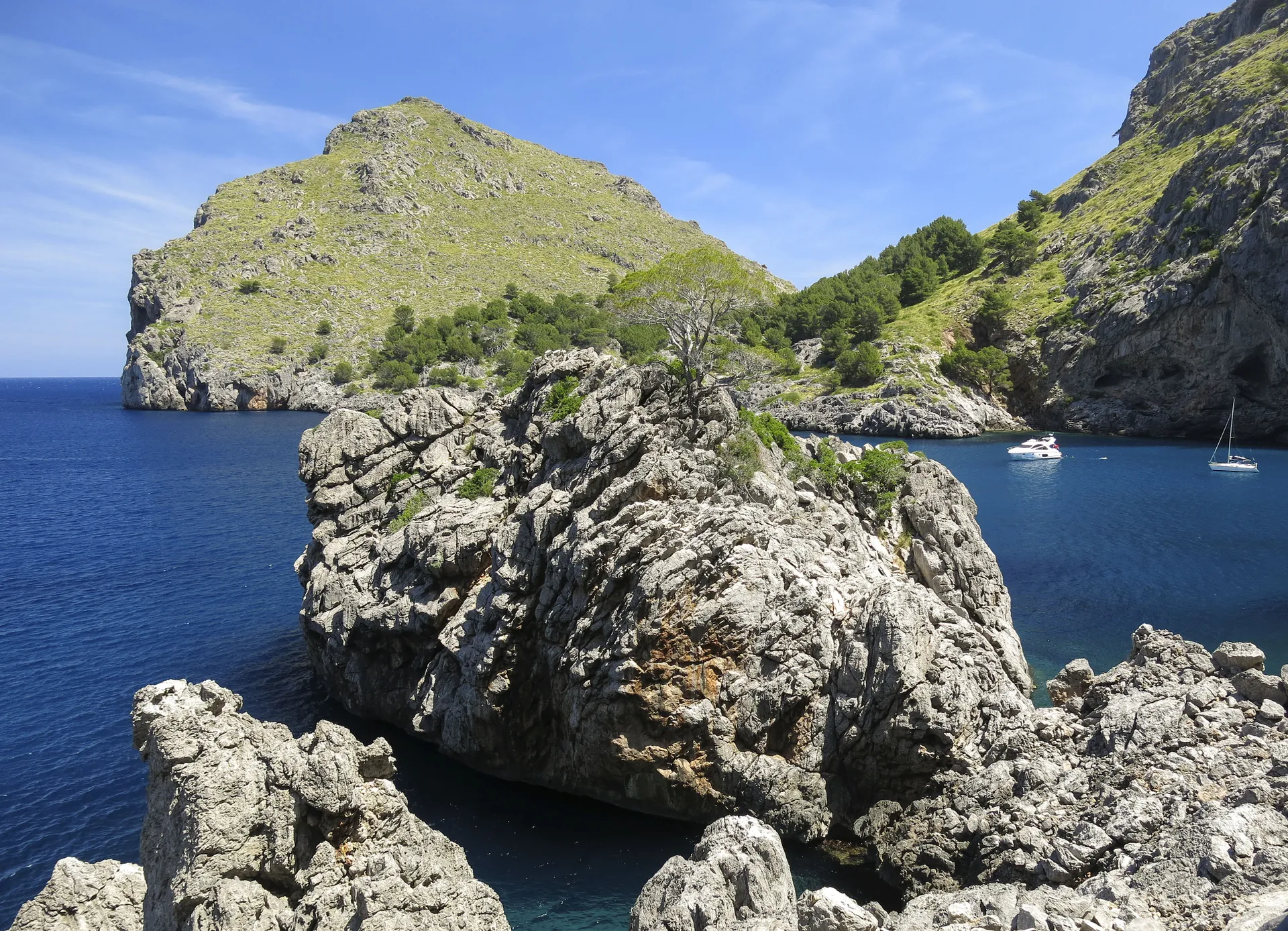
The hike takes between 4 and 6 hours and should only be attempted between April and October when the riverbed is dry. Do not attempt this alone if you are not an experienced mountain hiker. Many visitors prefer to take a boat from Port de Sóller to Sa Calobra to see the mouth of the canyon without the physical toll of the descent. If you do hike it, the reward is a swim in the crystal-clear waters of the cove at the end, which feels like a baptism after the dust of the gorge.
The Golden Valley and the Artist’s Coast
The Serra is dotted with villages that feel like they have been carved out of the mountain itself. Sóller is the largest, sitting in a valley of orange and lemon trees that were once the source of the town’s immense wealth. The “Orange Express” vintage train still connects Sóller to Palma, providing a slow, nostalgic journey through thirteen tunnels. Just up the road is Fornalutx, which is frequently voted the most beautiful village in Spain. Its stone houses and flower-lined streets are impeccably preserved. If you have the time, visiting the millenary olive trees at the Jardí Botànic de Sóller is a must for nature lovers.
Further south lies Valldemossa, famous for the Royal Charterhouse where Frédéric Chopin and George Sand spent a winter in 1838. Sand’s book, “A Winter in Mallorca,” wasn’t particularly kind to us locals, but the village remains stunning nonetheless. It is a place of narrow alleys and green-shuttered houses, all overlooking a valley of olive trees. It is also where you must try a *coca de patata*, a light, sweet potato bun that is best eaten dipped in thick hot chocolate.
Then there is Deià, the village of the artists. For decades, it has been a magnet for writers and musicians, most notably the poet Robert Graves, who lived here for most of his life. His house, Ca N’Alluny, is now a museum. The village has a reputation for being expensive, mind you, but the walk down to Cala Deià for a plate of grilled fish at the water’s edge is worth every cent. You might even spot a celebrity; people like Michael Douglas and Brad Pitt have long been associated with the estates along this stretch of coast.
Wildlife and the Ancient Olive Heritage
Nature in the Serra is subtle. You won’t find large mammals, but if you look closely at the limestone pools in the deep gorges, you might see the *Ferreret*. This is the Mallorcan midwife toad, a tiny creature that was thought to be extinct until it was rediscovered in 1979. It only exists here, in the most remote corners of the Tramuntana. Above you, the Black Vulture (*Voltor Negre*) circles the peaks. Thanks to dedicated conservation efforts, the population of these massive birds—the largest in Europe—has recovered significantly in recent years.
The flora is dominated by the olive tree. Some of the trees in the Serra are over a thousand years old, their trunks twisted into shapes that look like modern sculpture. The olive oil produced here is protected by a Denomination of Origin (*Oli de Mallorca*) and has a distinctively peppery, intense flavour because of the mountain soil. Look for the “Can Det” label in Fornalutx; they still use traditional stone presses that have been in the same family for generations. It is a taste of history that has not changed much since the Roman times.
Practicalities: Driving and Weather
The MA-10 is the main artery of the Serra, a road that runs the entire length of the range. It is one of the most scenic drives in the world, but it is not for the faint-hearted. The stretch between Sóller and Lluc includes the *Nus de sa Corbata* (Tie-knot), a 360-degree turn where the road passes under itself. If you are not comfortable with heights or sharp bends, the public TIB buses are a great alternative. They are modern, air-conditioned, and the drivers handle the hairpins with terrifying ease. You can check the Mallorca Public Transport Guide for more details on routes.
Driving Tip: During the peak summer months, access to the Formentor lighthouse is restricted to private cars between 10:00 and 22:00. You must take the shuttle bus from Port de Pollença or you will face a hefty fine. This was occured to manage the traffic on the narrow peninsula.
Weather is the final thing to consider. The Serra has its own microclimate. It can be raining in Lluc while the sun is shining in Palma. Snow is rare but it does happen in January and February, often closing the mountain passes for a few days. If you visit in winter, the mountains take on a silver hue that is incredibly beautiful. For the best hiking conditions, aim for October to May. The light is clearer, the air is crisp, and you won’t be fighting the crowds that the summer heat inevitably brings to the coastal villages.
Explore the Serra de Tramuntana
Whether you are here to hike the GR 221, drive the winding roads, or simply sit in a village square with an ensaimada, the Serra de Tramuntana demands your time. It is not a place to be rushed. It is a place to listen to the wind, to touch the ancient stones, and to understand that Mallorca is much more than just a holiday island. It is a landscape that has shaped us, and once you spend a few days in its shadow, it will likely stay with you forever.
Spanish Cooking Experience in Mallorca
Horse Riding in Mallorca on the Beach and Forest
Kayaking and snorkeling in the Mondragó Natural Park in Mallorca
Palma de Mallorca and Valldemossa Excursion from Cruise Port
Deluxe Cruise-Friendly Mallorca and Valldemossa Tour
If you have more time to explore, consider visiting the Castell d’Alaró for a hike with a history lesson, or take a quiet afternoon at the Monestir de Miramar. Each corner of these mountains has a story to tell, provided you are willing to walk a little further to find it.
Serra de Tramuntana Interactive Map Placeholder