
The Stones That Speak
Walking the dirt path just outside Artà with my dog, Cala, the midday heat drops the moment we step into the shade of the holm oaks. The transition is sudden. You leave the modern tarmac of Camí de Sa Corbaia behind and come face-to-face with megaliths that have occupied this patch of earth for over three thousand years. This is the Poblat talaiòtic de ses Païsses. It is not just a pile of ancient rocks; it is a direct line to the island’s earliest inhabitants.
What Exactly is the Talayotic Culture?
Before the Romans arrived and stamped their grid systems across the Mediterranean, Mallorca belonged to a distinctly indigenous group. The Talayotic culture spans from around 1300 BC right up until the Roman conquest in 123 BC. These people built enormous stone towers and fortified villages that exist nowhere else in the world outside the Balearic Islands. The official Illes Balears Tourism archives classify these settlements as essential to understanding Bronze Age maritime societies. It is worth noting that whether visitors spell the island’s name Mallorca or Majorca—the latter being an older anglicised version—the deep historical roots remain identical.
The Monumental Portal: A Cyclopean Welcome
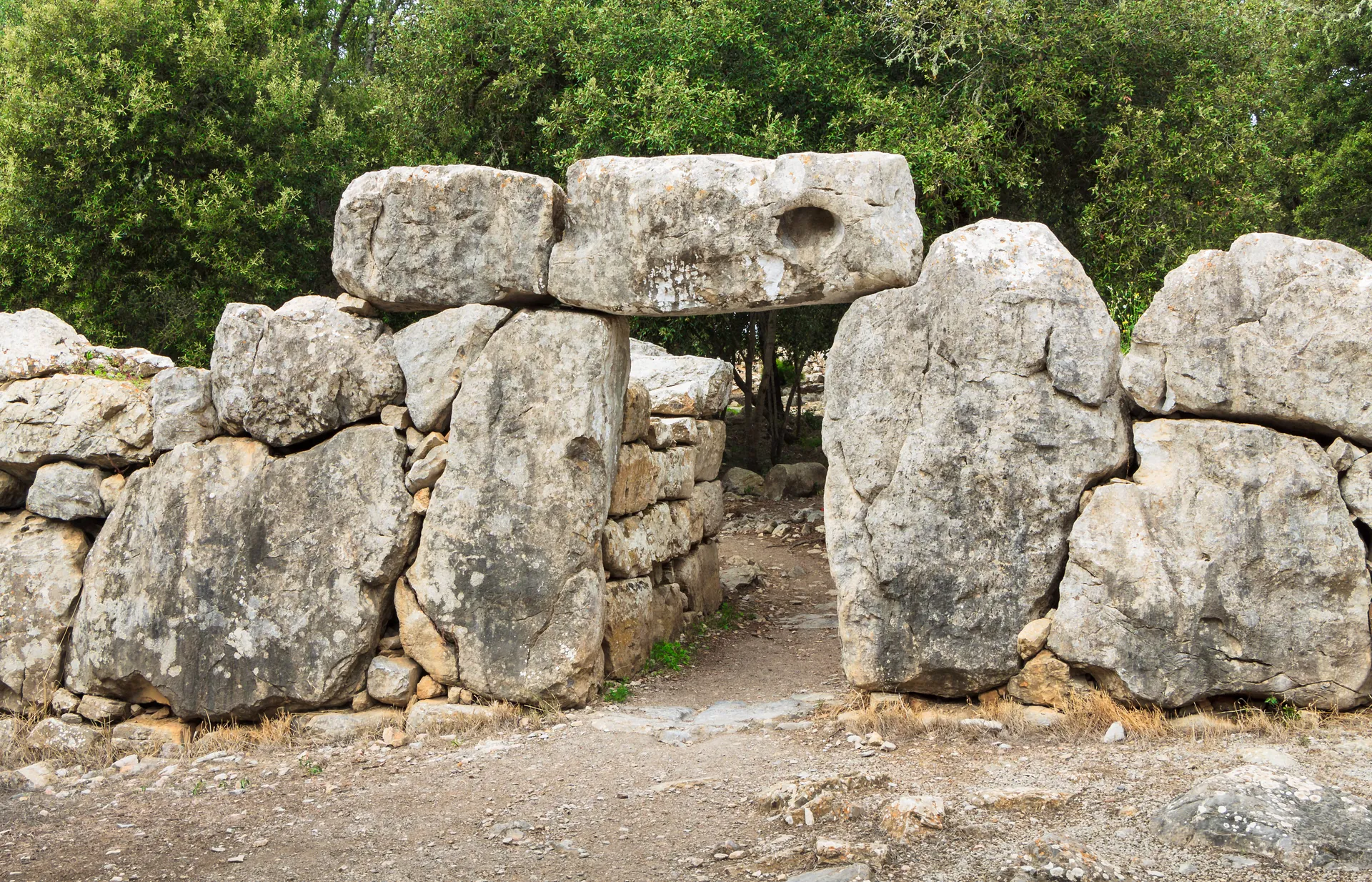
Approaching the main entrance, you pass under a massive stone portal. The sheer physical weight is heavy and unyielding. Three massive stone slabs, each weighing up to eight tonnes, form the doorway. The builders placed them perfectly without the use of mortar or wheels. They relied entirely on raw manpower and the rudimentary levers they had to work with. They stand exactly where they were dropped millennia ago.
The Central Talayot: The Heart of the Settlement
The nucleus of the village is the central talayot, a circular watchtower dating back to roughly 1000 BC. It measures 12 metres across. When you stand inside its ruined base, you can trace the original layout of the settlement radiating outward. The tower gave the community a vantage point over the surrounding plains, long before the perimeter walls were even necessary.
Daily Life Under the Holm Oaks
The surrounding forest of Quercus ilex is an integral part of the site. Early settlers relied heavily on these indigenous holm oaks. They gathered acorns for flour and forage, living in horseshoe-shaped dwellings that cling to the base of the central tower. Life here was deeply tied to the seasons and teh immediate landscape. You can almost hear the daily grind of grain when the wind moves through the canopy.
The Great Defensive Wall
Around 650 to 540 BC, the island’s security shifted. The threat of sea invasions grew, prompting the villagers to construct a massive defensive perimeter. This cyclopean wall stretches 374 metres around the settlement and averages over three metres thick. It is a proper barrier, mind you. The Consell de Mallorca’s heritage register notes that thanks to these defenses, the settlement remained inhabited well past the Roman conquest, likely until 50 AD.
Excavation History: Unearthing Ses Païsses
The layout we see today owes much to the Italian archaeologist Giovanni Lilliu. He began excavating Ses Païsses in the late 1950s, pulling the village back from the overgrown brush. At the site’s entrance, you will notice a stone monolith dedicated to the Mallorcan poet Miquel Costa i Llobera. He used these exact ruins as the atmospheric setting for his 1900 epic poem, La deixa del geni grec. He understood the gravity of the place intuitively, long before the formal trenches were dug.
Practical Logistics: Getting There and 2026 Updates
Directions & Parking
The site is roughly 300 metres outside the southeastern edge of Artà’s town centre. You just follow the signs down Camí de Sa Corbaia. There is a small dirt area for rental cars to park right by the entrance.
Admission & Hours
Admission is a highly affordable €4, proving that exploring Mallorca does not have to be expensive. Pay close attention to the seasonal siesta hours. The municipal workers are famously punctual. They will lock the gates exactly on time, so do not get caught lingering in the far corners of the woods.
Site Facilities & Local Etiquette
The local Artà Town Hall keeps the site accessible without ruining its character. You can buy cold drinks at the small wooden ticket kiosk, use the clean restrooms, and borrow laminated guidebooks to navigate the specific ruins. When ordering your tickets, a simple ‘Bon dia’ goes a long way. Locals speak Mallorquín, a regional dialect of Catalan, alongside Spanish. You can say ‘gràcies’ to say thank you, and they always appreciate the effort.
Visiting with Dogs
Artà is increasingly accommodating for pets, which is brilliant for us. Cala is always welcome to explore the shaded picnic perimeter, provided she stays on a leash and respects the archaeological zones.
Combining Your Visit: The Artà Itinerary
You can easily build a full day around Ses Païsses. After walking the ruins, head up into town to visit the imposing Santuari de Sant Salvador. Its fortified walls offer a fascinating architectural contrast to the Bronze Age stones. Alternatively, drive a short distance to explore the underground chambers of the Coves d’Artà. If you fancy exploring the broader landscape at a faster pace, there are some excellent quad excursions that run through the region.
A Quiet Continuity
Ses Païsses is a quiet continuity. The ruins are slowly being reclaimed by the forest. It provides a stark, peaceful alternative to the large coastal resorts. You leave feeling grounded, carrying a bit of that ancient stillness with you back onto the road.