
If you arrive in Palma by sea, the first thing that greets you is a wall of golden stone that seems to rise directly from the Mediterranean. This is La Seu, our cathedral, a building that has watched over this bay for nearly eight hundred years. For those of us who grew up in the shadow of its flying buttresses, it is more than a monument; it is the heartbeat of the island. I often find myself walking my dog, Cala, along the Parc de la Mar just as the sun begins to dip, watching the reflection of the sandstone shimmer in the saltwater lake below. It is a proper sight, mind you, and one that never grows old regardless of how many times you see it.
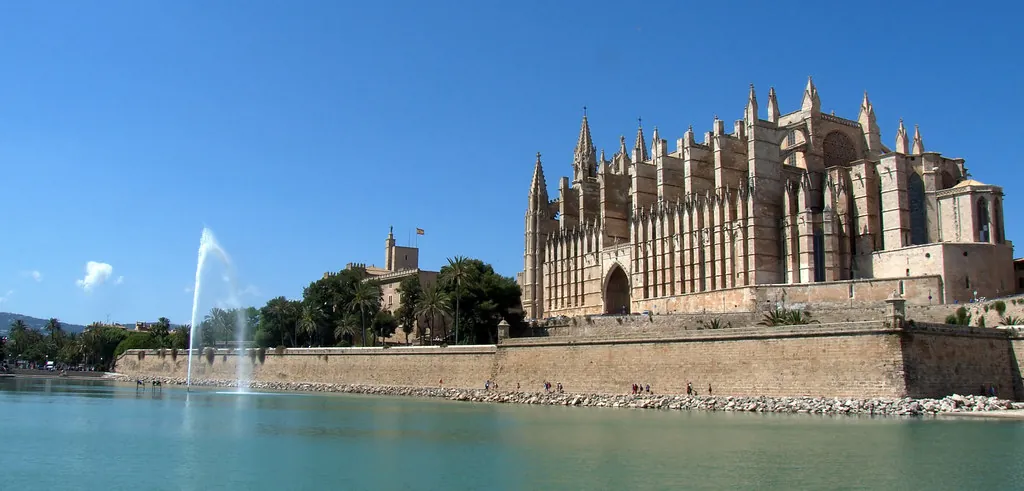
The Golden Sentinel of the Bay
The Cathedral of Santa Maria of Palma has a presence that is difficult to put into words. It occupies the site where the city’s main mosque once stood during the Moorish occupation. When King James I—Jaume I—conquered the island in 1229, he made a vow to the Virgin Mary after surviving a terrifying storm at sea. He promised to build a great temple in her honour if he reached land safely. Construction began shortly after, but a project of this scale was never going to be finished quickly. It took nearly four centuries to complete the main structure, which explains why you can see the evolution of Gothic styles as you walk around the exterior.
What makes the cathedral truly unique is its proximity to the water. In the past, the sea came right up to the base of the city walls, meaning the cathedral’s reflection was a permanent fixture on the waves. Following the construction of the Paseo Marítimo and the reclamation of land in the 1960s, that connection was severed, though the creation of the artificial lake in the park below has restored some of that old magic. If you are interested in how the city has changed, the [Official Website of Palma] provides excellent historical archives on the urban development of the waterfront.
The Stone of Santanyí
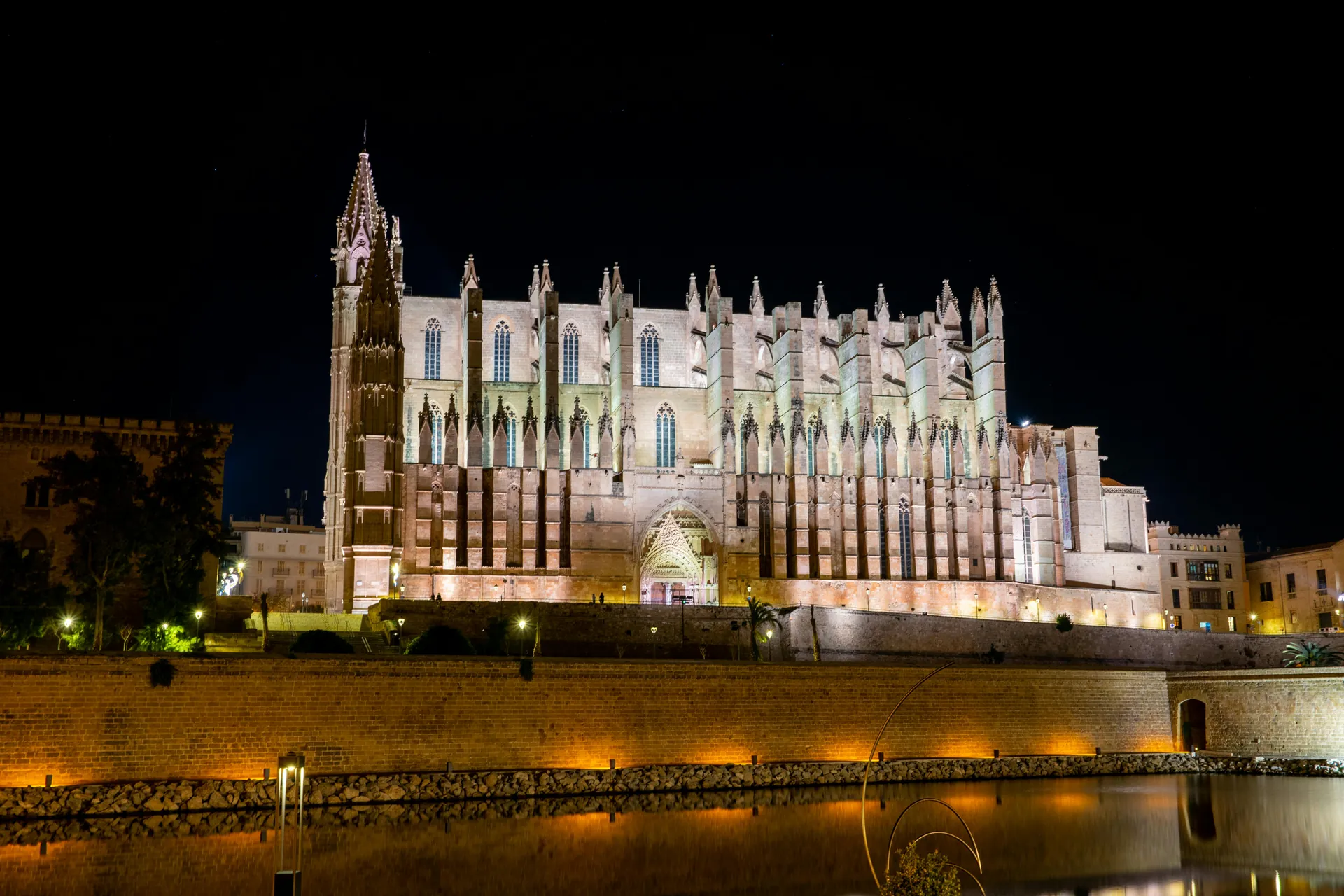
The material used for the cathedral is Santanyí stone, a local calcarenite sandstone quarried from the south of the island. It has a high concentration of iron oxide, which is why the building changes colour throughout the day. In the morning, it is a pale, creamy yellow. By midday, it turns a brilliant gold, and as the sun sets, it takes on a deep, dusty pink hue. It is a soft stone, easy to carve but vulnerable to the salty air of the Mediterranean.
A Maritime Landmark
Because of its height and position, La Seu has served as a lighthouse for sailors for centuries. Even today, when I am out on a boat in the bay, seeing that massive silhouette tells me I am home. It stands next to the Royal Palace of La Almudaina, creating a skyline that is arguably the most recognizable in all of Spain. The sheer scale of the buttresses is meant to convey power, but to me, they look like the ribs of a great stone ship anchored at the edge of the world.
The Oculus: The Gothic Eye
Inside, the cathedral is a cathedral of light. This is largely thanks to the great rose window, known locally as the Oculus. It is one of the largest Gothic rose windows in existence, measuring 12.55 metres in diameter. It contains 1,236 individual pieces of stained glass arranged in a geometric pattern of David’s stars. When the morning sun hits the eastern facade, the interior is flooded with pools of liquid colour that dance across the limestone floor. It is a transformative experience, one that makes the heavy stone feel almost weightless.
The “Spectacle of the Eight” occurs only twice a year. On February 2nd and November 11th, at approximately 8:30 AM, the light from the main rose window projects perfectly onto the opposite wall, creating a figure-of-eight of light below the smaller rose window on the western facade.
If you happen to be in Mallorca during these dates, you must arrive early. The doors open at 7:30 AM, and the cathedral is usually packed with locals and photographers waiting for the alignment. It is a moment of quiet collective awe. People often ask why Mallorca is so famous, and while the beaches are grand, it is these ancient displays of mathematical and architectural genius that provide the real soul of the island. It is a reminder that the builders of the 14th century had a relationship with the sun that we have largely forgotten in our modern age.
Gaudí and the Modernist Intervention
The cathedral remained largely unchanged for centuries until the early 1900s, when Bishop Pere Joan Campins invited the Catalan architect Antoni Gaudí to undertake a restoration. Gaudí’s work here was controversial at the time. He removed the heavy Baroque choir stalls that blocked the view of the altar from the nave, effectively opening up the space. He also introduced electric lighting and designed a massive, wrought-iron baldachin—a representation of the Crown of Thorns—that hangs above the altar. It looks like something from a dream, decorated with paper lanterns and glass ornaments that sparkle when the light hits them.
As 2026 marks the centenary of Gaudí’s death, there is a renewed interest in his Mallorcan legacy. Special lectures and guided tours are currently scheduled throughout May to highlight his contributions to La Seu. While his most famous work is in Barcelona, his ten years in Palma were foundational for his style. He didn’t just add things; he understood the light of the island. He was commisioned to bring the cathedral into the modern era without losing its Gothic spirit, and I believe he succeeded brilliantly. You can find more details on these centenary events on the [Cathedral’s Official Website].
Miquel Barceló’s Modern Sea
In 2007, the cathedral added another layer of history with the inauguration of the Chapel of the Blessed Sacrament, designed by the Mallorcan artist Miquel Barceló. He covered the walls of the chapel in a 300-square-metre ceramic mural that looks like the floor of the Mediterranean. It depicts the miracle of the loaves and fishes, but in a way that feels raw and contemporary. There are cracks in the clay, protruding ceramic fish, and sea caves that seem to breathe. Some locals were shocked by it initially—it is a stark contrast to the gold and marble of the rest of the building—but it has become a essential part of the cathedral’s identity.
Mateo’s Tip: Stand in the centre of the Barceló chapel and look up. The way the ceramic skin interacts with the light from the stained-glass windows makes you feel like you are underwater. It is a deeply Mallorcan tribute to the sea that sustains us.
Exploring the Soaring Nave
The sheer volume of the interior is staggering. The central nave is 44 metres high, making it one of teh tallest Gothic naves in the world. For comparison, it is significantly higher than Notre Dame in Paris. The pillars that support the roof are remarkably slender for their height, which gives the impression that the ceiling is floating. It is a feat of engineering that still puzzles architects today. Within the nave, you will also find the royal tombs. Both King James II and King James III of Mallorca are buried here, their remains resting in the Chapel of the Trinity.
Walking through the nave, you’ll notice the silence. Even with hundreds of tourists, the height of the space swallows the sound. It is a place for reflection. I often think about the generations of Mallorcans who have stood in this exact spot—through plagues, wars, and the arrival of tourism. The cathedral is the place I always return to. It anchors the city. If you have time after your visit, I highly recommend a short walk to the Museo de Mallorca nearby to see the Roman and Moorish artefacts that predate the cathedral.
Climbing the Terraces
If you are physically able, the rooftop tour is something you cannot miss. You have to climb a narrow spiral staircase of over 200 steps, but the reward is a perspective on the city that few get to see. You can walk among the flying buttresses and get a close-up look at the intricate stone carvings and the massive rose window from the outside. The views are what everyone comes for. From the top, you can see across the entire bay, out to Bellver Castle on its hill and the distant peaks of the Serra de Tramuntana.
Mind you, the rooftop tours are restricted to those over the age of nine and must be booked in advance. They sell out quickly, especially in the spring and autumn when the weather is perfect for climbing. There is something incredibly peaceful about being up there, away from the crowds of the Plaça de la Seu, with only the wind and the gulls for company. It makes you realize just how massive this undertaking was for the people of the 13th century.
The Museum of Sacred Art
Your entry ticket usually includes access to the Cathedral Museum, located in the old Chapter Houses. It is a treasure trove of religious artefacts, including massive silver candelabras, intricate vestments, and Baroque altarpieces. One of the highlights is the collection of Gothic paintings by local masters. It provides a fascinating look at the wealth and influence of the Church in Mallorca over the centuries. The Chapter House itself is a masterpiece of Baroque architecture, with a soaring dome that rivals the main cathedral in its detail.
Logistics and Visiting Tips for 2026
Planning a visting requires a bit of foresight. The cathedral is an active place of worship, so tourist visits are restricted during mass times. Dress code is strictly enforced: shoulders must be covered, and shorts or skirts must reach mid-thigh. I have seen many disappointed travellers turned away at the door for wearing beach attire. It is a sacred space, after all, and deserves a bit of respect.
| Ticket Type | Price (May 2026) | Inclusions |
|---|---|---|
| General Admission | €11.00 | Cathedral, Museum |
| Cathedral + Terraces | €25.00 | Full Access (Must pre-book) |
| Seniors (65+) | €9.00 | General Admission |
| Residents | Free | Fridays only (with Balearic ID) |
As for the opening hours, the summer season (March to November) sees the cathedral open from 10:00 to 17:15 on weekdays. On Saturdays, it closes earlier at 14:15. Sundays are reserved for religious services, though you are welcome to attend mass if you wish to see the building in its intended use. If you are looking for other things to do, check out our guide to Sightseeing Bus Tours which stop right in front of the palace.
Mateo’s Final Thoughts
Whenever someone asks me which part of Mallorca is the nicest, my mind always wanders back to the cathedral. It isn’t just about the architecture; it is about the way the building interacts with the island. It is the best month to visit Mallorca in May, as the air is fresh and the light is particularly crisp. After I finish a long day of writing or developing, I often grab Cala’s lead and head down to the waterfront. We walk past the fishermen mending their nets near the Llotja and end up at the foot of the cathedral walls. Seeing the sun hit those stones, turning them into a wall of fire, is a proper way to end the day. It reminds me why I never left this island, and why I probably never will.
If you’re planning your first trip, you might wonder about the practicalities. Is it rude not to tip in Mallorca? Not at all, though a small gesture is always appreciated in the cafes around the Plaça de la Reina. And if you’re worried about the language, while we speak Mallorquín among ourselves, almost everyone in the tourist areas speaks excellent English. Just a simple bon dia (good morning) or gràcies (thank you) will go a long way with the locals. Mallorca is a place that rewards those who take their time to look beyond the surface. La Seu is the perfect place to start that journey.