
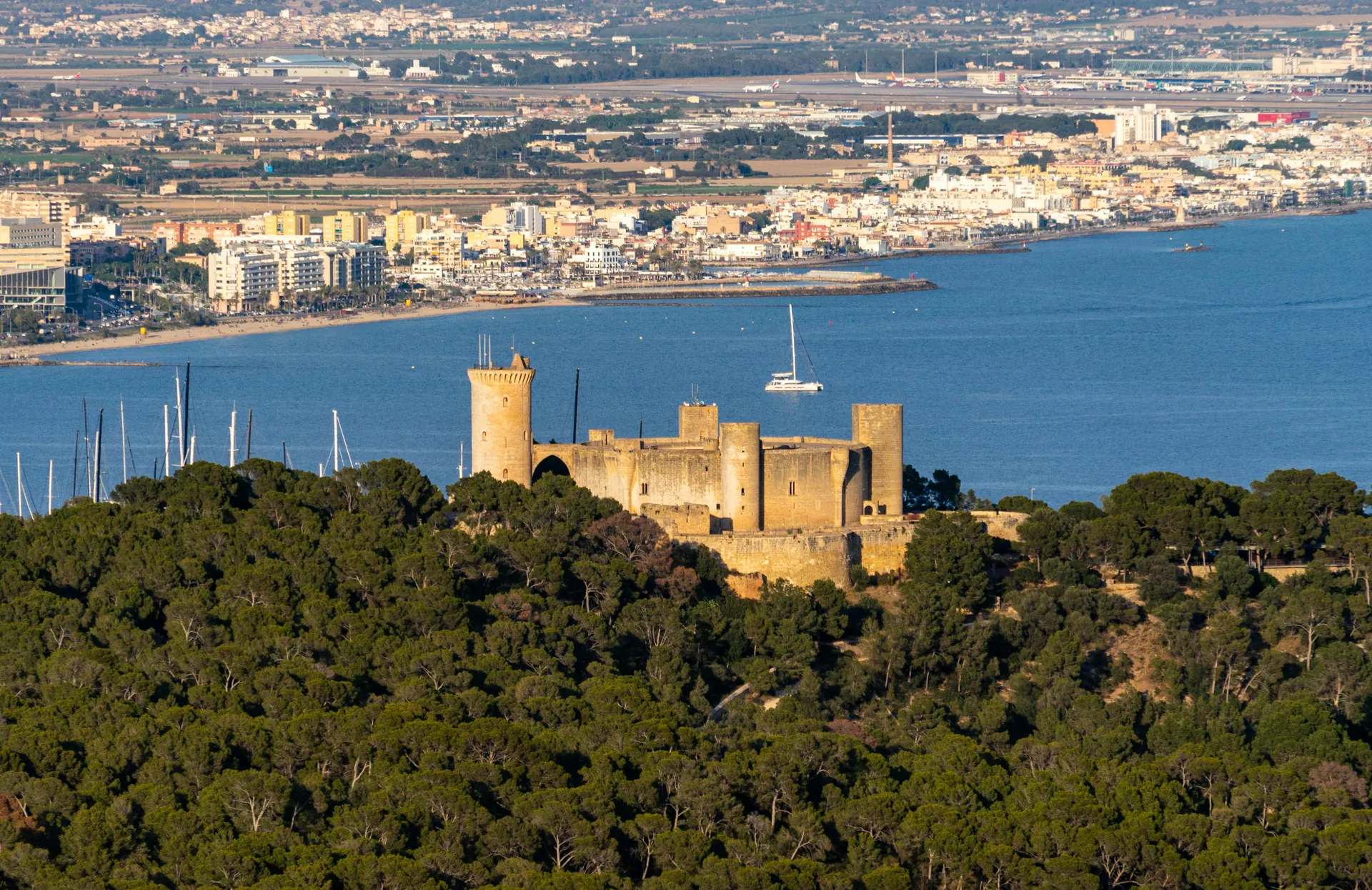
Morning dew still clings to the pine needles as Cala and I make our daily ascent. The scent of resin and damp earth fills the air, a familiar preamble to the imposing silhouette ahead. Sitting 112 metres above sea level, Castell de Bellver watches over the western flank of Palma Bay. It is a structure that commands attention without raising its voice. Most fortresses impose, mind you, but Bellver simply observes. The walk up through the woods is a ritual for many locals. We leave the concrete grid of the city behind and step into a pocket of wild nature. The sounds of traffic fade, replaced by the crunch of dry carob pods underfoot and the distant chime of church bells from the old town.
A King’s Round Ambition
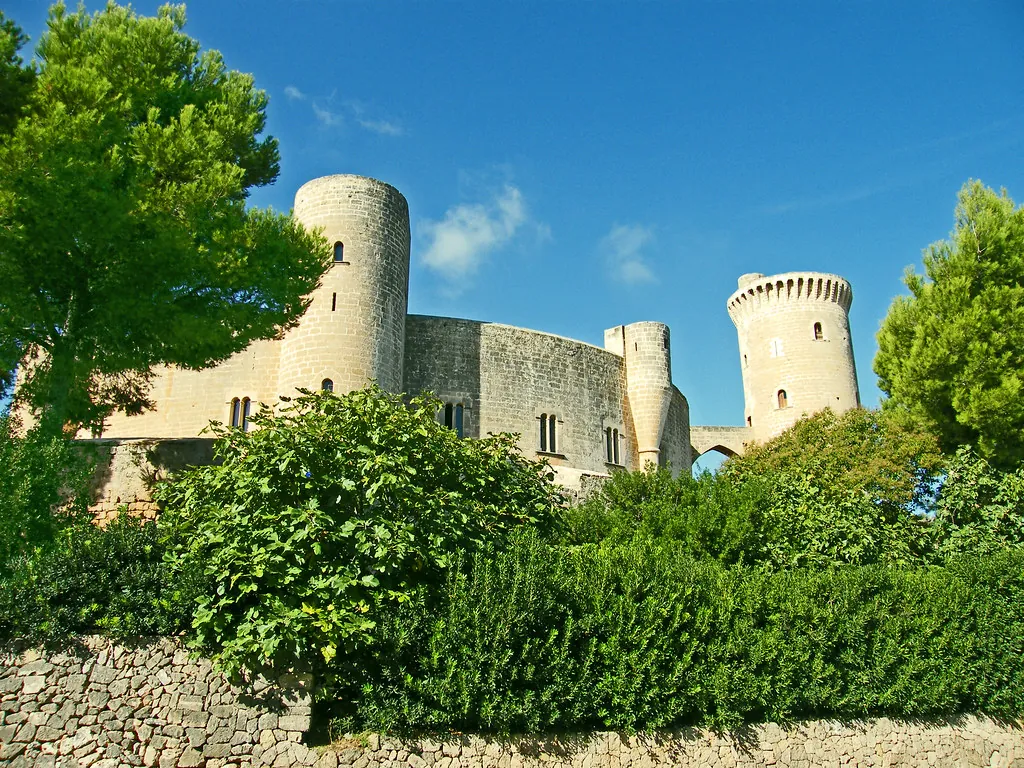
King Jaime II of Mallorca ordered its construction in the early 14th century, selecting Pere Salvá as his chief architect. Salvá was already a respected figure, having worked on the nearby Almudaina Palace. With Bellver, they built something entirely unique. The castle is a masterpiece of Catalan Gothic design and the only circular Gothic castle in Spain. The building is a perfect circle. Three large circular towers attach directly to the main defensive ring. A fourth, the massive Torre de l’Homenatge (Tower of Homage), is completely detached. It points north and connects to the main fortress by a solitary stone arch. This layout is a stark departure from the angular military fortresses typical of medieval Europe. The circular design was not merely an aesthetic choice; it eliminated blind spots for the defending archers. The continuous curve of the outer wall meant that any attacking force was exposed to defensive fire from multiple angles simultaneously.
Walking through the Castell de Bellver Forest Park is an experience in itself. This green expanse is the lung of Palma. Old carob, Aleppo pine, and wild olive trees line the dirt paths, offering essential shade during the intense summer months. It is a proper spot for a morning walk, and Cala always finds a new trail to explore on the steep hill we’re trekking up. The woods are full of life, from red-legged partridges darting into the underbrush to local runners tackling the incline. If you visit in early 2026, be aware that the main access bridge over the defensive moat is undergoing a much-needed restoration. Visitors currently enter through the south door.
“The contrast between the austere outer walls and the delicate inner courtyard is staggering. You cross a heavy defensive threshold and suddenly find yourself in an elegant palace.”
Mateo Valero
Crossing the Defensive Threshold
Before you even reach the central courtyard, you must navigate the outer defences. The fortress is surrounded by a deep, dry moat. Historically, this ditch prevented siege engines from getting close to the outer walls. Today, it provides a fascinating perspective on the sheer height of the stonework. Visitors cross a bridge over this moat to enter the complex. The original drawbridge mechanism is long gone, replaced by a permanent stone and wood structure. Stepping through the main portal feels like walking directly into the fourteenth century.
The central courtyard reveals a two-tiered gallery that defines the internal character of the castle. The ground floor has stout Romanesque semicircular arches, while the upper level displays delicate Gothic pointed arches. The contrast between the heavy military exterior and this elegant inner cloister is remarkable. The acoustics in this circular courtyard are flawless. During the summer months, the city occasionally hosts classical music concerts here. The sound bounces perfectly off the curved stone walls, creating an auditory experience that rivals any modern concert hall. It was originally a royal summer residence intended for courtly leisure, a place for the kings of Mallorca to escape the heat and politics of the city below.
From Royal Splendour to Dark Cells
History had other plans. From the 18th century through the mid-20th century, the castle was a political prison. The very walls that protected royalty became a cage for dissenters. High-profile inmates spent years confined within these damp stone cells. The most notable was Gaspar Melchor de Jovellanos, a prominent figure of the Spanish Enlightenment, who was imprisoned here from 1802 to 1808. He did not waste his time in captivity. Jovellanos commissioned the first botanical and geological studies of the surrounding forest. Later, during the Spanish Civil War in the 1930s, the castle held hundreds of Republican prisoners. If you look closely at the stonework in some of the lower galleries, you can still see the faint scratchings and graffiti left behind by desperate men.
Today, the ground floor contains the City History Museum. The exhibits trace the urban evolution of Palma and show various archaeological artefacts recovered from the island. You walk through rooms dedicated to the Roman era, where classical statues from the Despuig collection sit quietly under the vaulted ceilings. Further along, the Moorish period is represented by intricate ceramics from the time when Palma was known as Medina Mayurqa. People often ask what food Palma is famous for after seeing the old market displays and medieval dining artefacts. A proper ensaïmada or a thick slice of rustic sobrassada is always the right answer, best enjoyed at a local bakery after your visit. You can read more about these delicacies in our guide to Traditional Mallorcan Foods.
| Bellver Castle Visitor Logistics (2026) | Details |
|---|---|
| Opening Hours (Apr – Sep) | Tue – Sat: 10:00 – 19:00 | Sun: 10:00 – 15:00 |
| Opening Hours (Oct – Mar) | Tue – Sat: 10:00 – 18:00 | Sun: 10:00 – 15:00 |
| Admission Prices | General: €4 | Concessions: €2 | Sundays: Free |
| Official Contact | casbellver@palma.es |
The Rooftop Panorama and Getting There
Travellers frequently wonder if Mallorca is cheap or expensive. Admission to Bellver Castle is incredibly reasonable, costing just a few euros, and Sundays offer completely free entry. It is a budget-friendly way to spend a morning, especially for families. A common query is whether Mallorca is the same as Majorca. It is the exact same island. The word “Majorca” is simply the anglicized spelling, though locals always use the double ‘L’. When planning your trip, considering the Best Time to Visit Mallorca helps you avoid the peak summer heat and the heaviest crowds.
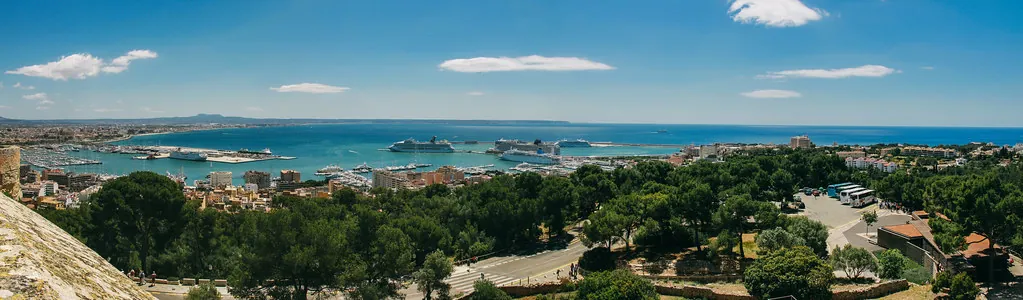
The name Bellver translates to “beautiful view” in Catalan. Climbing the narrow spiral stone staircase to the flat rooftop proves the name is entirely justified. You get an uninterrupted 360-degree panorama. To the south, Palma Bay stretches out in a wash of deep blue, dotted with the white sails of yachts and the bulky silhouettes of ferries heading to the mainland. To the north, the rugged peaks of the Serra de Tramuntana rise sharply against the sky, their grey limestone faces catching the afternoon light. Looking east, you can easily spot the colossal silhouette of Palma Cathedral and the adjacent Royal Palace of La Almudaina. The sheer scale of the landscape from up here puts the entire island into perspective. You can see how the city grew from a tight medieval core into a sprawling modern capital.
Getting there requires a bit of effort. You can catch the local EMT buses (Route 50 is the official hop-on-hop-off tourist bus) which stops right at teh gates. Alternatively, you can walk up through the pine forest from the El Terreno neighbourhood or the Paseo Marítimo. The walk takes about twenty minutes from the bottom of the hill. It involves a series of stone steps that zigzag through the trees. For detailed transit advice across the island, review our Mallorca Public Transport Guide. Be mindful of the summer heat if you choose the walking route and always carry water. There is a small café near the parking area, but it is often busy.
People frequently ask how many days in Mallorca is enough. While you can see Palma in a weekend, truly exploring the island requires at least a week. If you only have a few days, Bellver Castle is an absolute must-do. Another common question from visitors is what to be careful of in Mallorca. When visiting historical sites like Bellver, the main hazard is the sun. The rooftop offers zero shade, and the Mediterranean sun is unforgiving in July and August. Always wear a hat and apply sunscreen before making the climb. You should also wear sensible shoes. The ancient stone steps are uneven and have been worn smooth by millions of footsteps over the centuries.
For official tourism updates, you can check the Palma Tourism Board or verify historical details via the Balearic Islands Government Portal. If you want to dive into the island’s history further, the Official Castell de Bellver site has extensive archival records. Should you fancy seeing the bay from the water later, booking a Palma de Mallorca Boat Trip is a brilliant way to spend your afternoon.
Bellver is a constant in the Mallorcan skyline. It watches over the city day and night, a silent witness to centuries of change. Whether you come for the medieval history, the panoramic photography, or simply a quiet walk through the pines with your dog, the castle leaves a lasting impression. It is a reminder that Palma is much more than just a beach destination; it is a city with deep roots and towering stone ambitions.