
There is a specific kind of silence found only at the southern tip of Mallorca, where the land finally gives up its struggle against the Mediterranean. Most visitors spend their time tangled in the winding ribbons of the Serra de Tramuntana or lost in the narrow alleys of Palma, but those who crave a more honest, unvarnished version of the island eventually find their way to the Far de Cap Blanc. It is a place of stark horizontal lines and vertical drops, where the acantilados (cliffs) fall away into a blue so deep it feels heavy.
I often come here with my dog, Cala, when the humidity in the centre of the island becomes too thick to breathe. We drive down the MA-6014, a road that feels entirely un-Mallorcan because it is so stubbornly straight. It cuts through the dry plains of Llucmajor, flanked by ancient stone walls and the low-slung garriga scrubland. By the time you reach the lighthouse, the air has changed. It carries the sharp, metallic tang of salt and the scent of wild rosemary, mind you. This isn’t the manicured Mallorca of the postcards; it is the “White Cape,” a sentinel that has watched over the maritime traffic of the south for over a century and a half.
A Legacy of Light
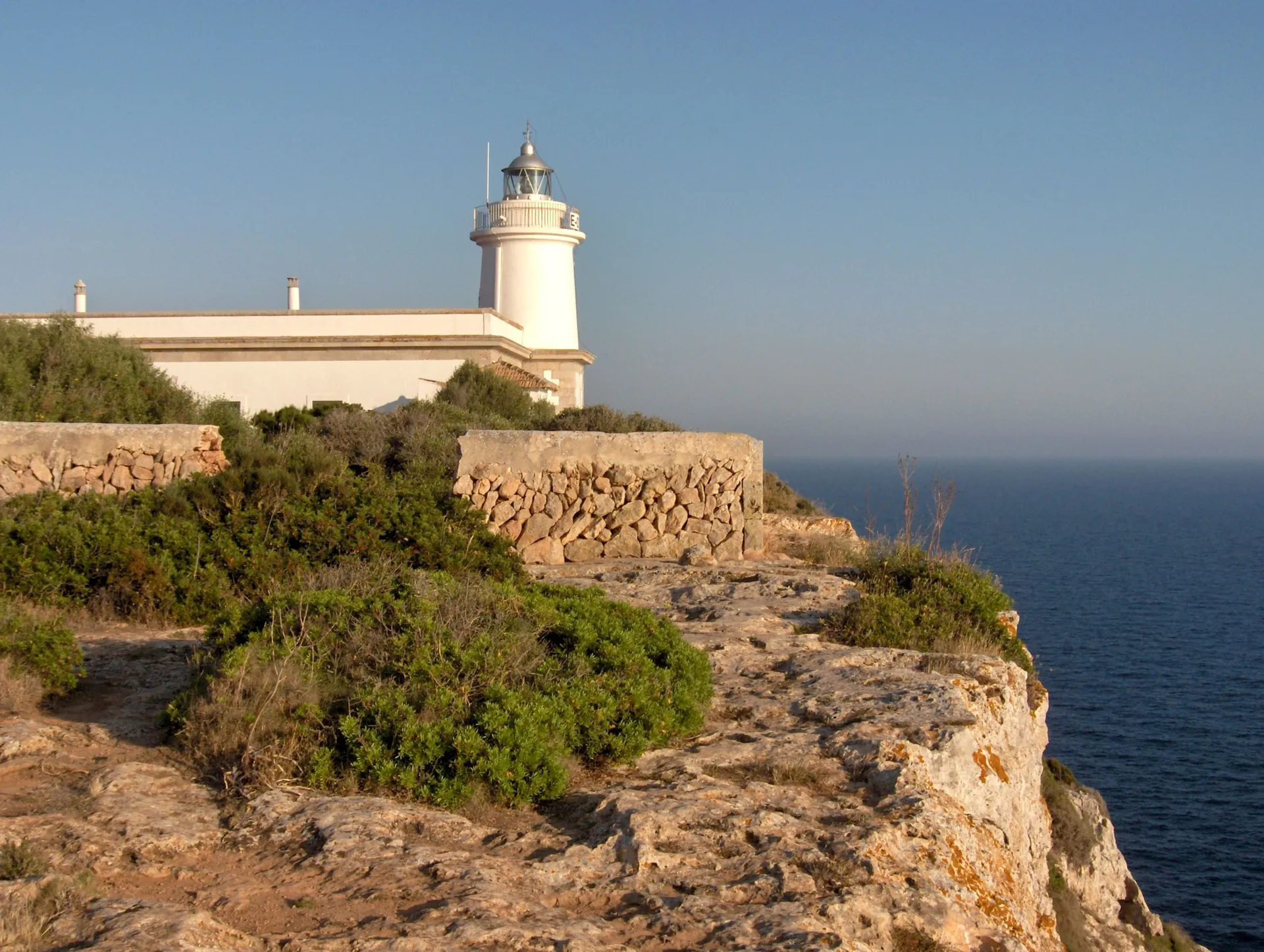
The history of the far (lighthouse) is inextricably linked to Emili Pou, the prolific engineer who designed most of the Balearic beacons. When it was first lit on the night of August 31, 1863, the light was fueled by olive oil, a resource Mallorca had in abundance. It was a massive undertaking to build on these isolated cliffs, requiring stone to be hauled across teh parched landscape. In those early days, the lighthouse keepers lived a life of profound isolation, tending to the flame and watching the horizon for ships navigating the treacherous southern approaches to the Bay of Palma.
Over the decades, the technology evolved from olive oil to paraffin, and eventually, the station was electrified in 1970. Despite these modern updates, the tower itself remains a modest, functional piece of architecture. It stands only 12 metres tall, but because it sits atop a 90-metre cliff, its focal plane is high enough to be seen from 15 nautical miles out at sea. According to the [Ports de Balears](https://www.portsdebalears.com/), it remains an active and vital part of the island’s maritime safety network, even as GPS has replaced the old ways of navigating by sight.
| Feature | Detail |
|---|---|
| Elevation | 95 metres above sea level |
| Tower Height | 12 metres |
| Inauguration | 1863 |
| Access | Exterior grounds only |
| Parking | Roadside pull-offs (Free) |
The Architecture of the White Cape
The design of the lighthouse is classic Emili Pou. It features a white cylindrical tower that rises from the centre of a U-shaped keeper’s dwelling. This domestic wing is finished in a simple, lime-washed aesthetic that reflects the brutal southern sun. While the interior is closed to the public—it is still a working signal station—the exterior provides a perfect example of 19th-century utility. The stark whiteness of the lime against the deep, bruised purple of the sea at dusk is something quite special.
Geologically, Cap Blanc is part of a massive limestone plateau. These cliffs are composed of calcarenite, a type of limestone that contains high amounts of shell fragments. This is what gives the cape its name; in the midday sun, the cliffs glow with an almost blinding white intensity. This limestone is porous and fragile, which is why you see so many jagged inlets and collapsed sea caves along this stretch of coast. It is a landscape that is slowly, inevitably, being reclaimed by the water.
If you are bringing your dog, keep them on a lead. Cala is well-behaved, but the lizards here—the sargantanas—are quick and tempting. One wrong leap near these 90-metre drops is a risk you simply cannot take. There are no fences at the cliff edge, so your safety is entirely your own responsibility.
Mateo Valero
Walking the Coastal Path from Cala Pi
While many people simply drive to the lighthouse, the real way to experience this coast is by foot. There is a coastal path that runs from the nearby beach of Cala Pi all the way to the lighthouse. It is a linear route of about 6 kilometres, taking you along the very edge of the plateau. The terrain is flat, but it is incredibly rocky and uneven. You will need proper boots, as the sharp limestone can shred a pair of thin-soled trainers in a single afternoon.
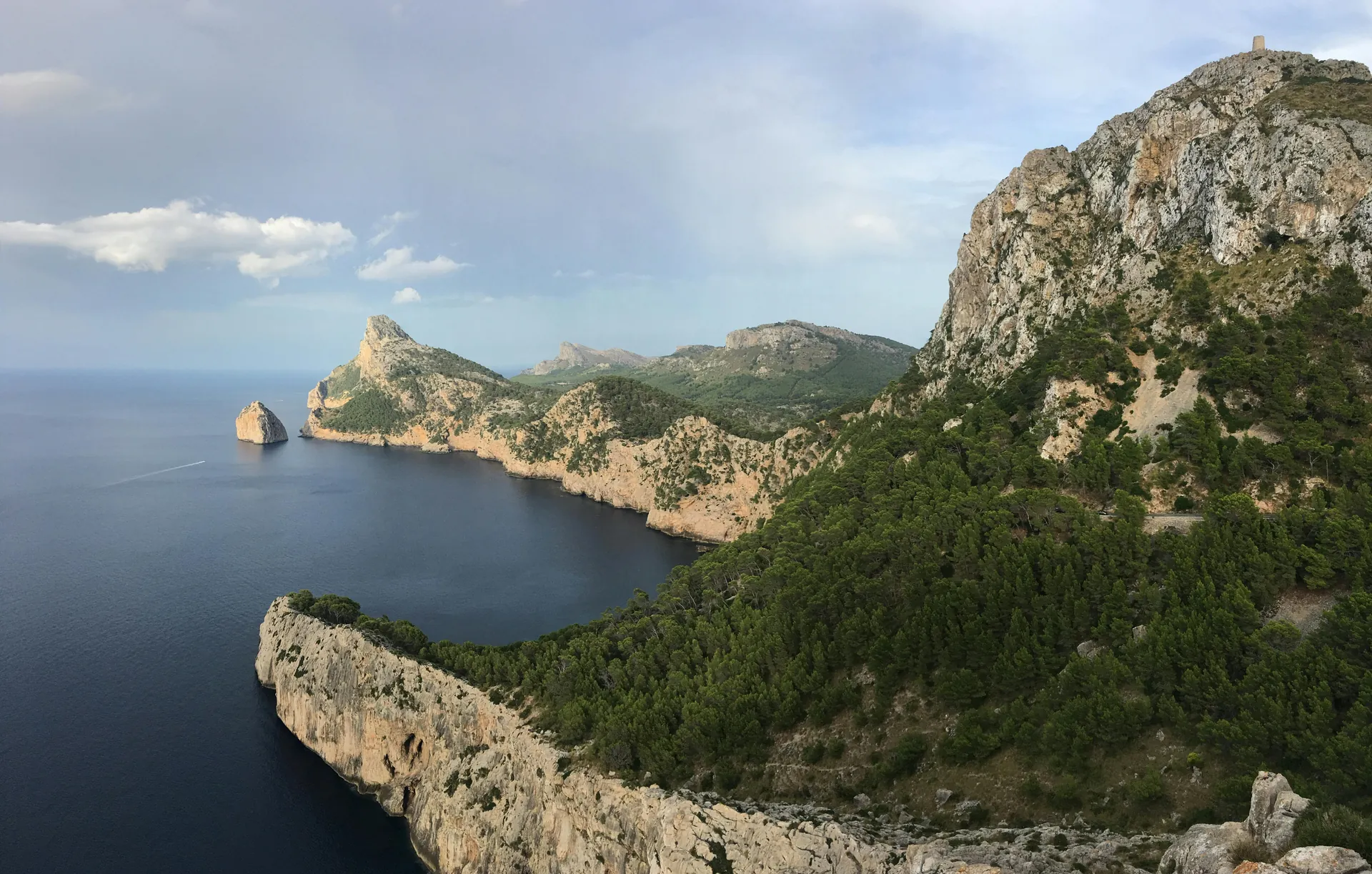
As you walk, you pass through the garriga, the low Mediterranean scrub that defines much of southern Mallorca. You will see wild olive trees stunted by the wind and thickets of mastic shrubs. On a clear day, the silhouette of the Cabrera Archipelago National Park appears on the horizon like a ghost ship. It is one of the most solitary walks on the island, far from the tourist-heavy trails of the north. You might encounter a few local fishermen or a stray Eleonora’s falcon circling above, but otherwise, it is just the sound of the wind and the rhythmic crash of the waves far below.
The Military Zone and Sunset Rituals
Adjacent to the lighthouse lies a restricted zona militar. You will see the barbed wire fences and warning signs as you approach. While it adds a slightly forbidding atmosphere to the area, it has also prevented the kind of runaway development that has ruined other parts of the coastline. This is why Cap Blanc feels so empty and preserved. You are free to walk the paths outside the fence, but do not be tempted to cross it or fly a drone directly over the installations. The authorities here take these boundaries seriously.
The military presence makes the sunset experience here realy unique. Unlike the Talaia d’Albercutx or Formentor, there are no cafes, no buskers, and no gift shops. It is a place for a proper picnic. I usually pack some sobrassada (cured pork paste with paprika) and a loaf of pa de pagès. Watching the sun sink into the water from these heights is a humbling experience. As the light fails, the lighthouse begins its rotation, a steady pulse of white light that has guided sailors for generations. It is a moment of quiet reflection that reminds you why Mallorca is so famous; it isn’t just the beaches, but these rugged, lonely corners that hold the island’s soul.
The south of Mallorca is often overlooked by those seeking ‘pretty’ villages, but Cap Blanc offers a different kind of beauty—one that is raw, ancient, and entirely indifferent to the modern world.
Nearby Exploration: History and Hidden Coves
If you have made the trip down to Cap Blanc, you would be remiss not to visit the Poblado Talayótico de Capocorb Vell. Located just a few minutes away by car, this is one of the most significant archaeological sites in the Balearics. These Bronze Age stone structures, or talayots, provide a glimpse into the lives of the island’s earliest inhabitants. The [Consell de Mallorca](https://web.conselldemallorca.cat/) has done an excellent job of preserving the site, and walking among the ruins feels like a natural extension of the ruggedness of the cape.
After a dusty afternoon of hiking and history, the nearby Cala Pi offers the perfect antidote. It is a narrow fjord-like inlet with emerald water and a small sandy beach. While it can get crowded during the peak months, a late afternoon swim here is the best way to wash off the salt and dust of the cliffs. For those looking to explore further afield, the southern coast is dotted with hidden spots like Cala s’Almunia, though these require a bit more effort to reach. The south is a region that rewards the patient traveler, those willing to drive the straight roads and walk the rocky paths.
Spanish Cooking Experience in Mallorca
Horse Riding in Mallorca on the Beach and Forest
Kayaking and snorkeling in the Mondragó Natural Park in Mallorca
Palma de Mallorca and Valldemossa Excursion from Cruise Port
Deluxe Cruise-Friendly Mallorca and Valldemossa Tour
Practicalities and Safety
- Parking: There is no official car park. Most people park on the wide dirt verges of the MA-6014 near the lighthouse entrance. Ensure your car is fully off the tarmac to avoid fines.
- Facilities: There are none. No toilets, no water fountains, and no shade. Bring more water than you think you need, especially if you are walking the coastal path.
- Footwear: The terrain is exceptionally sharp. Sandals are a recipe for a twisted ankle or a cut foot. Sturdy shoes are essential.
- Sun Protection: There is zero cover at the cape. The wind can be deceptive, making you feel cooler than you actually are while the sun burns.
- Timing: Morning is best for bird watching and clear views of Cabrera. Sunset is best for the atmosphere, though the drive back in the dark requires care due to stray goats on the road.
Many people ask if Mallorca is cheap or expensive, and the answer often depends on how you travel. A trip to Cap Blanc costs nothing but the fuel to get there, yet it provides a more profound experience than many of the expensive beach clubs in the southwest. It is a reminder that the best things the island has to offer are often the ones that have been there the longest, unchanged by the shifting tides of fashion. It is a place I often find myself returning to.
The Silent Sentinel
As the night settles in and the tourists retreat to their hotels in Palma or the resorts of the east, the Far de Cap Blanc continues its work. It is a lonely existence for a building, standing on the edge of a precipice, battered by the tramuntana and scorched by the sun. But for those of us who live here, it is a comforting presence. It marks the boundary between the known world of the island and the vast, unpredictable Mediterranean. Whether you come for the photography, the hiking, or simply the chance to stand at the edge of the world, Cap Blanc will leave its mark on you. It is a testament to the enduring power of the sea and the quiet strength of the Mallorcan landscape.
Before you leave the area, consider stopping at a local celler in Llucmajor for a traditional meal. Trying the local tumbet (a vegetable bake) or a hearty fideuà is the proper way to end a day in the south. You can find more advice on navigating the island in our Public Transport Guide, though for Cap Blanc, a rental car is almost certainly a necessity. Mallorca is a place of endless variety, and this white cape is one of its most essential chapters.