
In the east of the island, where teh limestone meets the salt-heavy air of the Mediterranean, there is a place that feels like it belongs to another world entirely. The Coves del Drac, or Caves of Drach, are more than just a geological curiosity; they are part of our local identity here in Mallorca. When I was a boy, my grandfather used to tell me about the winged serpent that lived in these depths, guarding a treasure that no pirate or knight could ever hope to reach. Even now, as a grown man who has walked these paths dozens of times, that sense of mythic weight never quite leaves me.
The Descent into the Underworld
Entering the caves involves a transition that is as much about the senses as it is about the scenery. You leave the heat of the Mallorcan sun behind and descend 121 steps into a world where the temperature is a constant 21°C. It is a relief for the skin, mind you, but the humidity is thick, often reaching 80%. I usually leave my dog, Cala, at home for this trip. The caves have a strict no-pets policy, and besides, the steep, damp stairs are no place for a golden retriever to be wandering around in.
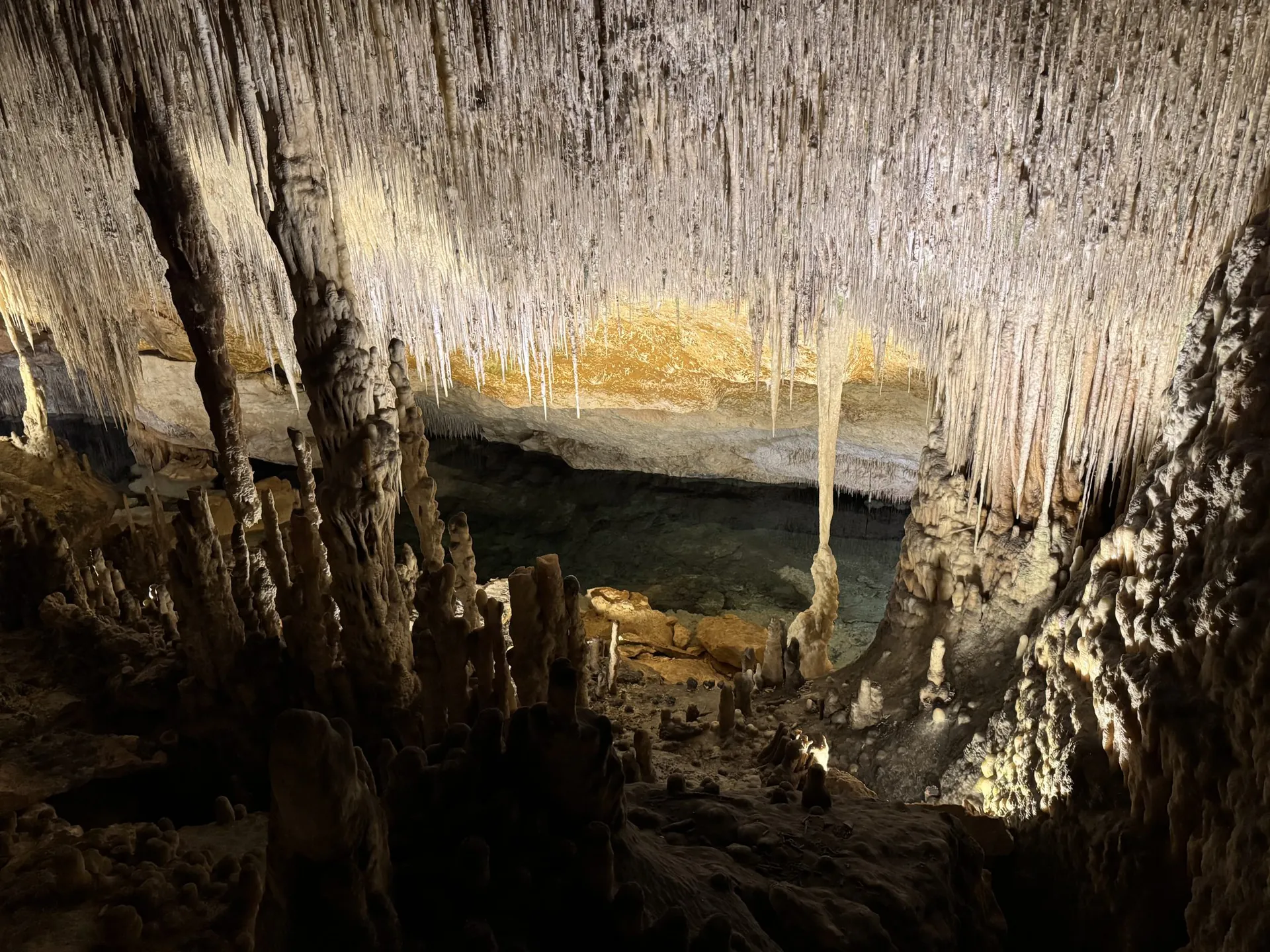
The route spans about 1,200 metres, taking you through four distinct chambers: the Black Cave, the White Cave, the Cave of Luis Salvador, and the Cave of the French. Each has its own character. The stalactites hang from the ceiling like frozen needles, and the stalagmites rise to meet them over thousands of years. It is a slow, silent conversation between rock and water. If you have visited the Coves de Campanet or the Cuevas de Génova, you will recognize the limestone patterns, but the sheer scale here is what sets Drach apart.
The 1896 Expedition
While the caves were known since the Middle Ages, they were realy put on the map in 1896. Édouard-Alfred Martel, a French explorer who is the father of modern speleology, discovered the massive subterranean sea that now bears his name. His expedition was a daring feat of early science, mapping out the depths using nothing but ropes and basic lamps.
The Wizard of Light
In 1935, the experience changed forever thanks to Carles Buïgas. He was a Catalan engineer known as the “Wizard of Light.” He designed the atmospheric illumination that guides you today. He understood that the caves don’t need bright, harsh bulbs. Instead, he used soft glows to accentuate the shadows and the natural textures of the stone, creating a dreamlike environment.
Lake Martel and the Concert on the Water
The climax of the visit is Lake Martel. It is one of the largest subterranean lakes in the world, stretching over 170 metres in length. The water is so clear and still that it acts as a perfect mirror for the formations above. Visitors are seated in a natural amphitheatre facing the water, and then the lights go out. In the total darkness, the sound of a distant violin begins to echo off the walls.
The music has a way of making the cave feel alive, as if the very stone is breathing along with the cello.
A quartet of musicians—two violins, a cello, and a harpsichord—appears on small rowing boats that are illuminated by tiny lanterns. They glide across the water while playing pieces by Chopin, Offenbach, and Caballero. It is a ten-minute performance that has remained virtually unchanged for decades. After the concert, you have the choice to cross the lake yourself on one of the boats or take the bridge. I always recommend the boat; it is a short trip, but being that close to the water in the heart of the earth is a proper Mallorcan experience.
Planning Your Visit
If you are coming from Palma, the journey is straightforward. You can take the Ma-15 highway toward Manacor and then follow the signs to Porto Cristo. For those who prefer public transport, the TIB Bus 401 runs from the Estació Intermodal in Palma directly to the caves. It is a journey of about 90 minutes, but it allows you to see the rolling landscape of the Pla de Mallorca along the way.
| Ticket Type | Online Price | Box Office Price |
|---|---|---|
| Adult (13+) | €18.00 | €19.00 |
| Child (2-12) | €11.00 | €12.00 |
| Infant (0-1) | Free | Free |
You must buy your tickets in advance on the Official Website. The entry times are strictly controlled, and if you miss your slot, the ticket is gone. I suggest booking the 10:00 or the 17:00 slot. These are usually the quietest times, and you avoid the largest of the tour bus crowds that arrive midday. Photography is allowed inside the caves, but you cannot use a flash or a tripod. During the concert itself, filming and photography are strictly forbidden. The wardens are very quick to stop anyone who tries, and it ruins the atmosphere for everyone else, so just keep the phone in your pocket and enjoy the moment.
Beyond the Caves: Porto Cristo
Once you emerge back into the daylight, do not just rush back to your car. Porto Cristo is a lovely fishing village that has managed to keep some of its original charm despite the fame of the caves. It is a wonderful place to walk along the harbor. If you are hungry, look for a spot serving Tumbet, which is a traditional vegetable dish you can read about in our guide to Traditional Mallorcan Foods. It is a hearty meal that will set you up for the afternoon.
Local Tip: Just a few minutes away is the Majorica Pearl factory. Mallorca is famous for its organic man-made pearls, and watching the artisans at work is a fascinating way to spend an hour before heading back to Palma.
Some people say the Caves of Drach are too touristy. They are popular, yes, but they are popular for a reason. There is nowhere else on the island where the history of the earth and the beauty of human music come together in such a way. It is a place you really should go to. Just remember to bring a light jacket for the humidity and leave the dog at home with a bowl of water and a shady spot to nap.