
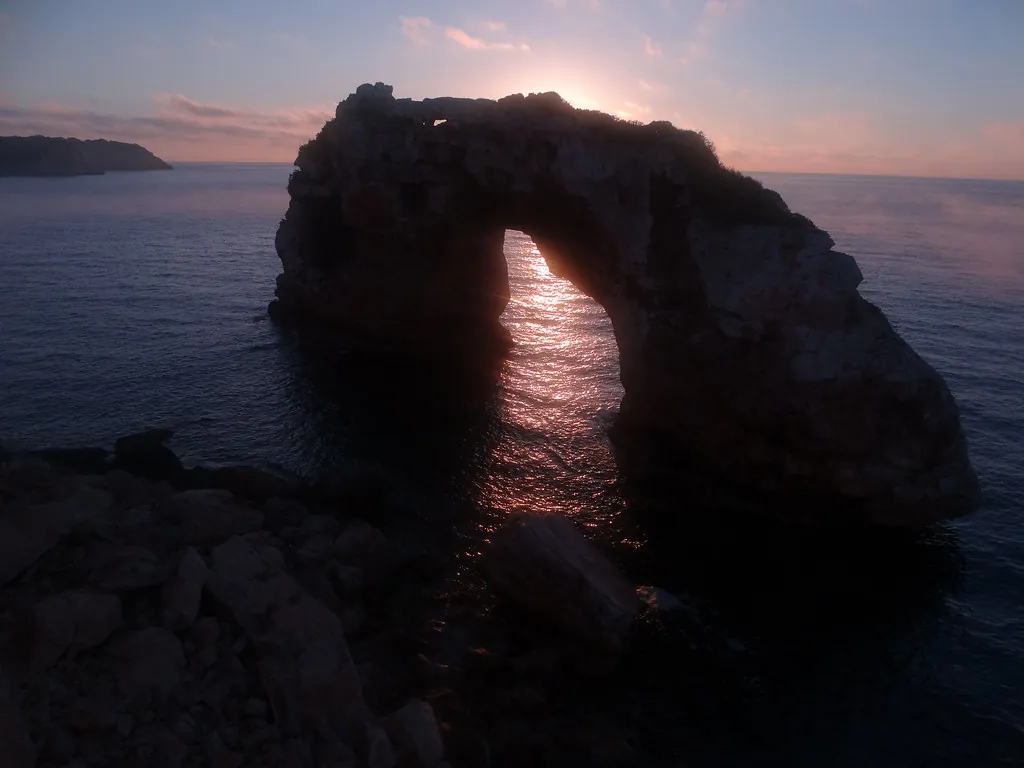
There is a specific kind of silence that only exists on the edge of the Mediterranean just before the sun breaks the horizon. I often find myself standing on the craggy limestone cliffs of Santanyí, usually with my dog, Cala, sniffing at the salt-crusted shrubs, watching the first light hit Es Pontàs. It is a massive, freestanding natural arch that rises twenty metres from the turquoise depths, a stone bridge to nowhere that has become a symbol of our island’s raw, unyielding beauty. While many visitors flock to the cathedral in Palma or the heights of the [Serra de Tramuntana](/places/serra-de-tramuntana/), those of us who grew up in the south-east know that this limestone sentinel is where the soul of the coast truly resides.
A Million-Year Masterpiece: The Geology of the Arch
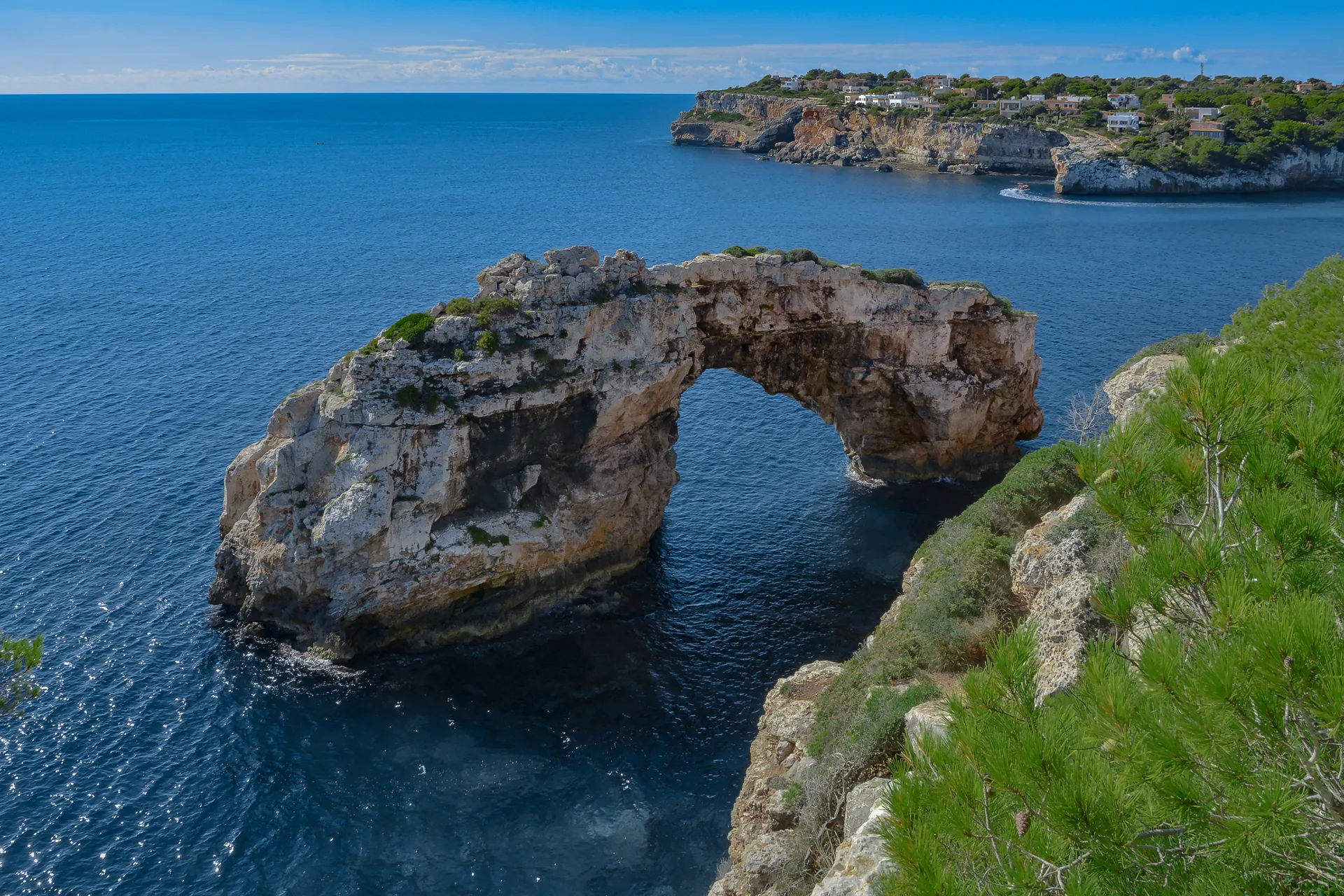
The story of Es Pontàs is one of patience and the violent grace of the sea. This isn’t just a rock; it is a remnant of a collapsed karstic cave system that once honeycombed this entire coastline. Millions of years ago, during the Upper Miocene, the Santanyí Limestone Formation was laid down in shallow seas. Over eons, the relentless pounding of the waves eroded the softer stone, leaving behind this marine abrasion arch as a solitary survivor of a roof that once connected these cliffs to the mainland. It is a fragile sort of permanence, mind you, as the same forces that created it will eventually reclaim it.
The rock itself is incredibly sharp, a textured grey and honey-coloured stone that tears at the soles of flimsy shoes. If you look closely at the surrounding cliffs, you can see S’Olla, a nearby inlet that was formed by a similar collapse. It serves as a reminder that teh landscape here is constantly in motion, even if it appears static to our fleeting human eyes.
- Height: 25 metres (82 feet)
- Material: Miocene Limestone
- Location: Santanyí Municipality
- Access: Footpath from Cala Santanyí
Navigating the Trail with Cala
To reach the best vantage point, you must head to the residential fringes of Cala Santanyí. The path begins at the end of Carrer de sa Cova des Vell Marí. It is a short walk, perhaps fifteen minutes, but the terrain is notoriously uneven. I always keep Cala on a short lead here because the limestone outcrops are jagged and the drops are sudden. There are no guardrails or safety nets; it is just you, the wind, and the drop. This lack of “tourist proofing” is exactly why teh spot remains so special to locals.
Local Tip: Do not attempt this walk in flip-flops. The limestone is “llabritja” (slippery and sharp), and you will want proper boots to keep your ankles intact while you find the perfect viewing angle.
As you walk, you will pass through a landscape of low-lying Mediterranean scrub, dominated by wild olive trees and mastic shrubs. On a hot day, the air smells of baked earth and pine resin. Eventually, the ground levels out into a natural Mirador (viewpoint) where wooden benches have been placed for those who want to linger. This is where most people stop, but if you are sure-footed, there are several little goat paths that lead to different perspectives of the arch. It is a place you simply have to get to.
Sunrise vs. Sunset: The Photographer’s Dilemma
Most visitors make the mistake of coming here for sunset. While the sky might turn a lovely shade of pink, the arch itself is often cast in deep shadow during the late afternoon. For a proper experience, you must arrive for the sortida de sol (sunrise). Because Es Pontàs faces east, the morning light illuminates the inner curve of the arch, turning the stone into a glowing orange crown. It is also the only time you will have the place to yourself, save for a few local fishermen or the occassion climber preparing their gear.
| Season | Best Time to Arrive | Crowd Level |
|---|---|---|
| Spring (March-May) | 06:30 AM | Low |
| Summer (June-August) | 05:45 AM | Moderate |
| Autumn (Sept-Nov) | 07:15 AM | Low |
| Winter (Dec-Feb) | 07:45 AM | Very Low |
Psicobloc: The Climbing Legacy of Chris Sharma
You cannot talk about Es Pontàs without mentioning Psicobloc, or Deep Water Soloing. In 2006, the legendary American climber Chris Sharma completed what is widely considered the most famous climbing route in the world on the underside of this arch. Climbing without ropes over the churning sea, he established a line that was unheard of at the time. Watching the footage from the documentary [King Lines](https://www.sharmaclimbing.com/) still gives me vertigo, even though I have seen the arch a thousand times. This route, graded 9a+, cemented Mallorca’s reputation as the global capital for this discipline of climbing.
The arch isn’t just a landmark for climbers; it is a “King Line,” a natural feature so perfect and challenging that it defines a person’s career.
— Local Climbing Guide in Santanyí
Even if you aren’t an elite athlete, you will often see boats anchored in the blue water below the arch during the summer months. Climbers from across the globe come here to test their grip on the “tufas” (limestone ribs) of the arch. It is a spectator sport for those of us on the cliffs, watching them fall gracefully into the deep water when their strength finally fails. If you’re interested in more water-based adventures, you might want to look into [Snorkeling and Kayaking](/activities/snorkeling-kayaking-paddleboarding/) around the nearby coves.
The “Equilibrio” Sculpture: Art Meets Nature
On the approach to the arch, you will encounter a series of stone columns that seem at once ancient and modern. This is the “Equilibrio” sculpture by the German artist Rolf Schaffner. It is part of a larger, pan-European project consisting of five stone markers placed in strategic locations across the continent to symbolise peace and ecological balance. The Santanyí columns are particularly striking because they echo the verticality of the cliffs and the arch itself. They serve as a quiet reminder that we are merely custodians of this coastline, tasked with preserving its integrity for the next generation. You can find more about the local cultural heritage at the [Official Santanyí Portal](https://ajsantanyi.net/).
Legend of the Sea Spirits
Our folklore is thick with tales of the sea. Some old-timers in the village still whisper about the esperits de la mar (spirits of the sea) that use the arch as a portal. It is said that during the full moon, the arch becomes a gateway between our world and the deep, and that the whistling of the wind through the stone is actually the song of those who were lost at sea. Whether you believe the myths or not, there is an undeniable energy at Es Pontàs on a stormy night when the waves are high enough to spray the very top of the bridge.
Practicalities: Parking and Logistics
Accessing Es Pontàs is remarkably straightforward, which is rare for such a dramatic site in Mallorca. There are no entrance fees and no gates. You can park for free on the streets of Cala Santanyí, specifically around the residential area near the trailhead. During the peak of summer, these spots fill up by mid-morning, so another reason to arrive early. If you are relying on public transport, the [TIB Bus Line 516](https://www.tib.org/) connects Santanyí town to the beach, but do check the seasonal schedules as they change frequently.
- Parking: Free street parking on Carrer de sa Cova des Vell Marí.
- Facilities: None at the arch. Nearest toilets and cafes are at Cala Santanyí beach (1km away).
- Safety: Stay well back from the edge; the limestone can crumble without warning.
- Environment: Take all rubbish with you. There are no bins on the cliff path.
Nearby Coastal Escapes
Once you have had your fill of the arch, the surrounding area offers some of the best swimming on the island. A short drive or a longer coastal hike will take you to [Cala s’Almunia](/places/cala-s-almunia/), a tiny fishing cove with crystal clear water and traditional stone huts. Alternatively, the beach at Cala Santanyí is perfect for a post-hike dip and a plate of pamboli at one of the local chiringuitos. If you’re staying in the area, I highly recommend visiting the [Wednesday and Saturday markets in Santanyí](/places/santanyi-market/) to pick up some local salt and artisan crafts. This part of the island is famous for its slow pace of life, which is a welcome change from the “party island” reputation Mallorca sometimes carries in the British press.
Spanish Cooking Experience in Mallorca
Horse Riding in Mallorca on the Beach and Forest
Kayaking and snorkeling in the Mondragó Natural Park in Mallorca
Palma de Mallorca and Valldemossa Excursion from Cruise Port
Deluxe Cruise-Friendly Mallorca and Valldemossa Tour
Before you leave this corner of the south-east, take one last look at the arch. It has stood there for thousands of years, watching empires rise and fall, surviving the trampling of tourists and the fury of the winter gales. For me, and for Cala, it is more than just a photo opportunity; it is a grounding point, a piece of home that remains unchanged in an ever-changing world. Just remember to watch your step on the way back to the car, and perhaps stop for a coffee in the village to warm your bones after that early morning start.
Explore More of Mallorca
If you enjoyed the rugged cliffs of Santanyí, you might also like to explore the [Caves of Drach](/places/caves-of-drach/) for more subterranean wonders, or perhaps drive west to see the [Torre del Verger](/places/torre-del-verger/) for more dramatic coastal viewpoints. For those interested in the island’s culinary secrets, don’t miss our guide to [Traditional Mallorcan Foods](/traditional-mallorcan-foods/).